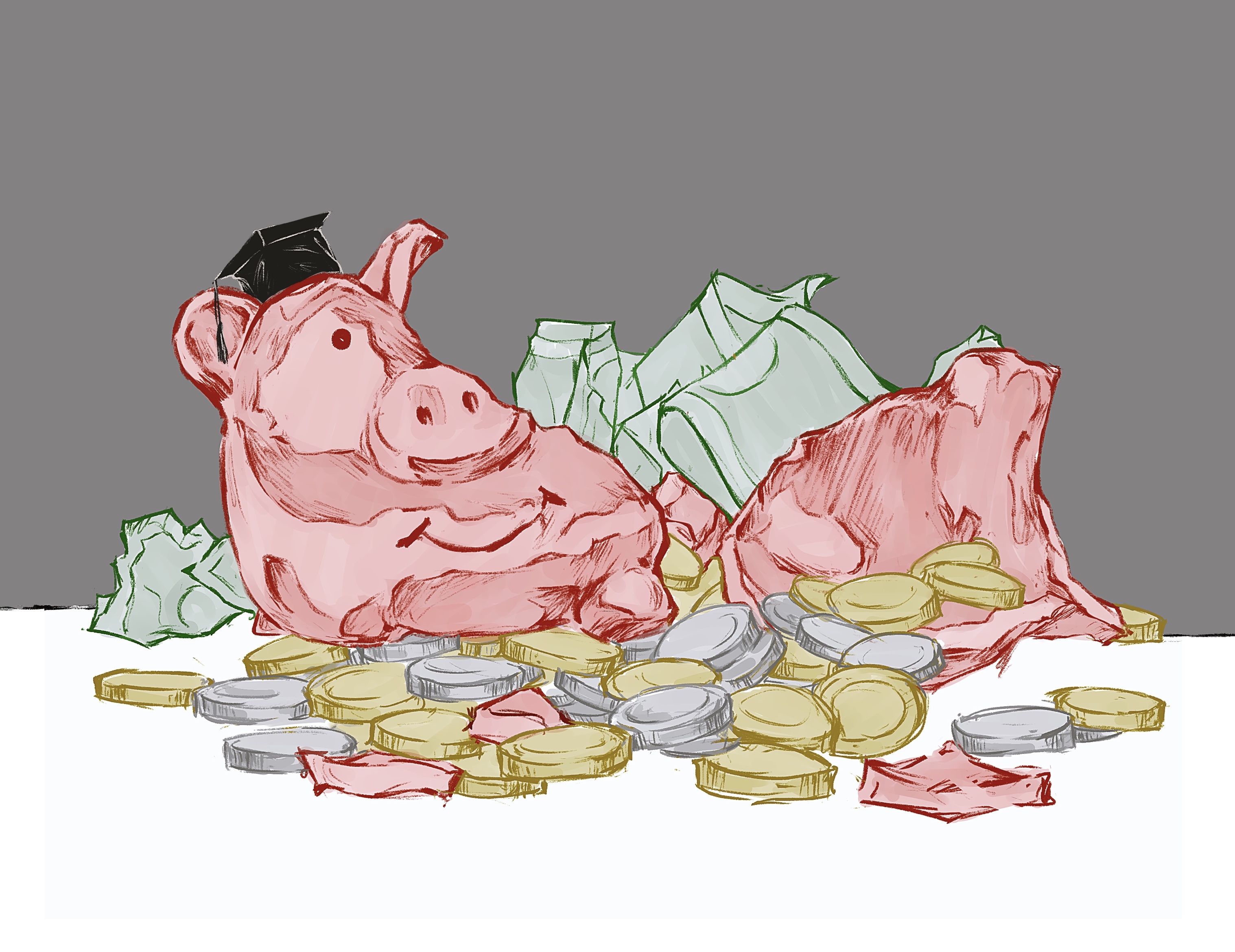

In recent years, protests and funding cuts have roiled campuses nationwide and brought increased scrutiny to university endowments. News of campus organizers pressing administrations to divest from Israeli companies, arguments that endowment money should be used to offset federal funding cuts, and accusations of general mismanagement have prompted questions about how universities allocate the billions of dollars that support research and education.
Below, the Maroon’s data desk has compiled information about how the University’s $10.9 billion endowment is managed.
The Maroon drew from three publicly available sources: Form 13F from the Securities and Exchange Commission (SEC), Form 990 from the Internal Revenue Service (IRS), and University reports. Form 13F is filed quarterly by institutions that manage over $100 million in assets, and Form 990 is filed annually by tax-exempt organizations. In addition to this data, the University commissions an annual financial report, which the Maroon supplemented with information from financial data sources available through the University library.
I. What Is an Endowment?
The endowment is just one of many sources that the University draws from to keep the lights on. The University’s income consists mainly of tuition, government grants, and the endowment. Tuition is collected from students and goes directly towards day-to-day operating expenses; the endowment, on the other hand, comes from private donors and is invested mainly as a rainy-day fund.
After tuition and other revenue are accounted for, universities withdraw an allowance from the endowment to cover remaining costs, amounting to about 4–5 percent of its total value per year. The remainder of the endowment is reinvested.
Usually, most of a university’s endowment is restricted, which means that donors have set rules determining what their donation can be used for and can punish the school for violating those agreements. For example, the Pearson family donated $100 million to the University in 2015 for the establishment of a global studies institute but later accused the University of contract breaches, including hiring underqualified faculty. In 2018, the Pearson family sued to recoup their funds.
According to the 2025 financial statement, about two-thirds of UChicago’s endowment consists of restricted funds. However, former President of Harvard University Larry Summers wrote last year that in emergencies, such as sudden loss of federal funding, even restricted funds can be used creatively.
At the University of Chicago, almost the entire endowment is merged into one pot called the Total Return Investment Pool (TRIP). The TRIP is in turn invested into various equities and assets. The major distinction here is between public equities—commonly known as “stocks”—and private equities, which are less regulated and typically involve higher risk. Because stock exchanges are regulated by the federal government, more data is available on public stocks than private equities.
Note that the total amount of investments is slightly more than the amount in the endowment. The University did not respond to a request for comment regarding the difference between general investments and the endowment.
Hover over the sections to view explanations for each category.
II. What Do We Know About How the Endowment Is Invested?
The University of Chicago possesses one of the 21 private university endowments in the United States with over $10 billion in funds. Still, although it was valued at $10.9 billion in 2025, it remains small among its peers.
Little is known about how the University’s endowment is invested. UChicago is a private university, so while it must comply with general reporting requirements for nonprofits, it is not subject to the more stringent requirements placed on public universities. Many private universities have refused to comply with public demands for transparency, because providing information about their investment strategies could give peer institutions a competitive edge, though UChicago has fulfilled narrower requests on some occasions.
But even for a private university, UChicago stands out: in 2023, Amnesty International rated the University as the least transparent among 10 peer institutions on categories such as as availability of information about the endowment and evidence of environmental-social governance investing.
Still, all universities do have some publicly available information, if one knows where to look.
Public Equities (Stocks)
The federal SEC requires all entities with significant investments to report on the amounts and names of stocks traded on public U.S. exchanges.
Data from the SEC reveals that UChicago has invested at minimum the following amounts across several industries as of September 2025. Hover over or tap each bubble to learn more.
However, SEC data represent less than 10 percent of UChicago’s public investments, and there is no way of knowing whether these proportions by sector are representative of the remainder of UChicago’s investments.
Private Equities
To provide information to donors and other interested parties, the University maintains some self-reporting on its finances.
Data compiled from the past 20 years of financial reports reveals that the University increased the proportion of the endowment invested in private equity from 20 percent in 2005 to 37 percent in 2025, accompanied by a decrease in the proportion of bonds. This tactic is consistent with the “Yale Model” investment strategy, popularized by David Swensen in 1985. In a departure from prevailing strategies of the time, Swensen posited that riskier investments in areas like private equity and international stocks would yield higher returns. This new approach quickly became widespread among universities.
When asked why the University chose to increase the proportion of its investments in private equity, a University spokesperson wrote in an email to the Maroon that the administration has chosen to withdraw from the endowment at a rate of 5.5 percent in recent years: “UChicago has deployed the endowment more aggressively than some peers to support academic priorities, which has helped us to consistently compete well with universities that have endowments that are multiple times the size of ours.” This exceeds the 4–5 percent of annual endowment earnings that is typically considered normal for institutions to spend. Thus, a more profitable investment strategy may be needed to support a higher drawdown rate.
Notably, the University of Chicago has taken somewhat less risk compared to peer schools:
[T]he University took a relatively conservative investment position after the financial crisis of 2008–2009... This does mean, though, that the University had lower returns than some peers with less conservative portfolios during the strong markets of 2010–2021.
III. Who Controls the Endowment?
The Board of Trustees acts as a steering committee for the Office of Investments, an entity within the Office of the President responsible for overseeing the endowment. The campus community has three avenues for providing input on investment strategy: the Council of the University Senate, a board comprising 51 elected faculty; the Graduate Council, which has five executive members and includes elected representatives from the 11 graduate divisions; and Advisory Councils, which are 14 councils with 10–95 members each, composed of “friends and alumni” of the University. Of these, only the Graduate Council appears to have regular meetings with the Board of Trustees, with a quarterly “Student Perspectives Series” running from 2016–2021 and 2024 onward.
A University representative stated in an email to the Maroon: “[The] Student Perspectives Series is one way for students to engage with trustees. Trustees also engage across the University with faculty, staff, and students in many ways including through various councils, speaking engagements, mentorship, and related interactions.”
The Office of Investments directly manages some of the endowment, but hires external asset-management firms to administer the rest. In an email to the Maroon, a University representative stated that the University currently works with 240 such external fund managers.
Because institutions outsource endowment management to third-party firms, some universities may not be aware of what their own endowments are invested in. When asked about this claim, a spokesperson wrote in an email: “The University’s investment team performs thorough due diligence to ensure that the funds in which it invests and their managers have no history of illegal behavior.”
Even if institutions are not aware of what their endowments are invested in, they have the power to find out. According to Brenden O’Connell, the chief investment officer at Leyland Cypress, a quantitative investment firm, any institution with a separately managed account (SMA) can request restrictions on their investments. “An SMA would be customized for you, usually. So you can impose constraints, [such as] you don’t want exposure to XYZ industries, and then the manager will tailor the portfolio accordingly”.
For example, in 2021, Harvard requested that its endowment no longer be invested in fossil fuel companies after years of calls for divestment. While campus activists at the University of Chicago have pushed for the same for years, the University has historically cited the Kalven Report, a 1967 declaration that the University must stay neutral in political contexts, as the main reason for its refusal to take action on the endowment. Activists counterargue that investment, as a means of financial support, is an inherently political act.
Using investments or other means to advance a social or political position held by some segment of the University community would only diminish the University’s distinctive contribution...The Kalven Report [concludes] that preserving the freedom of individual scholars to argue for or against any issue of political controversy requires ‘a heavy presumption against’ collective political action by the University itself.”
In a 2016 meeting with pro-divestment activists, former Trustee Tom Cole appeared to suggest that the responsibility for setting investment goals and managing the endowment lies primarily with the Office of the President, while the Board of Trustees provides oversight.
However, according to University governing documents ratified in 2010 and renewed through at least 2024, the president is ultimately “responsible, under the supervision of the Board, for the management of…investments, investment properties, and special property holdings in the neighborhood of the University”. In a 2015 interview with the Maroon, then-President Robert Zimmer confirmed: “Investments are the responsibility of the Board of Trustees.”
The only player on the chart with greater or equal power to the Board is a donor who marks any funds as restricted.
Conflicts of Interest
The IRS requires all nonprofits to list financial conflicts of interest in their tax filings. The Maroon’s review of these documents revealed that the University of Chicago has been hiring trustee-led asset management firms to manage its endowment.
In 2015, when the University nominated Man Group’s CEO Emmanuel Roman to its Board of Trustees, Man Group was paid $992,000 for managing the endowment. While the University may have worked with Man Group prior to 2015, any such work would not have counted as a conflict of interest and therefore would not have been reported. One year after Roman relocated to Pacific Investment Management Company (PIMCO), the University stopped employing Man Group and began employing PIMCO. It is unknown whether Roman is a member of the Board’s Investment Committee, which would indicate whether he has direct influence over the endowment.
The University has employed three other companies associated with trustees in similar capacities, despite its policy of avoiding actual or potential conflicts of interest with current trustees. Overall, the University has paid at least one investment firm with a conflict of interest every year since 2014. In 2024, the University stopped specific amounts paid to firms with conflicts of interest.
In response to the Maroon’s request for comment, the University wrote: “The University benefits from having Trustees with a range of backgrounds, including many in finance. The number and size of investments managed by Trustee-owned firms is low and we adhere to industry-leading conflict of interest policies. Trustee-managed firms currently manage a small number of funds accounting for less than 0.2% of the university’s endowment. They have added value overall, but have never been sizable enough to drive endowment performance.” 0.2 percent of the University’s endowment in 2025 is equivalent to about $20 million.
IV. Why Does This Matter?
Many members of campus have given statements on why they think greater transparency is needed. Below is a summary of some of their arguments.
The Argument for Moral Responsibility
When it comes to investment, one important distinction is between the primary and secondary markets. When a company goes public, it signals to the public that it needs to raise some amount of money, as indicated by its initial public offering. This is referred to as the primary market, which typically happens only once to kickstart a burgeoning company. What most people think of as the stock market is actually the secondary market, where players on the stock market buy and trade stocks with each other. Notably, the original company does not profit directly from the secondary market. For example, if the Maroon sold one share of Apple stock to Paul Alivisatos, Apple would not receive any proceeds from the transaction. Therefore, “investing in” a company does not necessarily financially benefit that company, at least when it comes to public equities.
Still, pro-divestment activists argue that investing in a company sends a message to the rest of the world, saying that the company’s products are valuable. The value of a company’s stock relates to its reputation with customers and potential third-party investors. Withdrawing investments from a company, in turn, can pressure it to reconsider or change its practices.
The Push for Institutional Transparency
Even before sweeping funding cuts took effect last year, professor Clifford Ando had dedicated 10 op-eds in the Maroon to criticizing what he sees as the University’s irresponsible management of funds, including a budget deficit that had been as high as $288 million in 2024. Following policy changes by the Trump administration, a controversial consolidation of the arts and humanities divisions and the departure of several key managers in the Office of Investments signaled further financial troubles for the University.
While the University announced in November 2025 that the deficit had been successfully reduced by almost half, Ando called for greater transparency and communication: “The University of Chicago’s pathology for secrecy regarding the simple facts of its own operations does not suggest confidence on the part of its leadership, despite their power. They should announce their vision proudly and provide the data for it to be analyzed and discussed.”
The push for transparency is not limited to UChicago. Many from have argued that it is the public’s right to understand the influence that elite institutions wield with their purses, especially if those institutions receive federal funding. In 2012, students at the University of California (UC), Berkeley expressed alarm after discovering that the UC system had invested in Bushmaster, a manufacturer of assault-style rifles. In 2024, Ohio State University students attempted to pressure their university to divest from holdings associated with the Israeli government, an effort that was stymied by an existing anti-divestment statute in Ohio state law. Even Congress has attempted to intervene, with both Democratic and Republican members unsuccessfully drafting legislation that would have required universities to be more accountable with their investments.
Some have also proposed alternative solutions for democratizing the endowment, such as letting students elect trustees, have direct representation on the board, or manage small portions of the endowment.
Balancing Fiscal Responsibility and Institutional Neutrality
If the goal of the endowment is to ensure financial stability for the University, it might not seem like a good idea to limit investment prospects, and, indeed, diversified portfolios are generally considered integral to investment strategy. In other words: don’t put all your eggs in one basket. Yet some firms argue that the financially responsible thing to do is to avoid including certain stocks, such as fossil-fuel producers, in an investment portfolio, given the volatility of non-renewable resources. Such arguments propose that institutions should take proactive approaches to investments, rather than preserve the “institutional neutrality” outlined in the Kalven Report, which the University has used in defense of its investment strategy.
O’Connell, the Leyland Cypress investment manager, pointed out that the mere idea of “maximal return” is controversial in the world of higher education. He gave a theoretical example of a $1 billion endowment: if a university invests the full amount and receives $100 million in profit, it might use about half of the profit to cover operating expenses such as professors’ salaries or student programming. Another $10 million or so is lost to inflation, leaving $30 million in excess. When universities reinvest this excess rather than spending on students or communities in need, “some people say that $30 million in pure profit is unnecessary,” O’Connell explained. “It just makes the endowment bigger and bigger.”
As endowments continue growing amid federal cuts to
university budgets, some
question
whether their original purpose as safety nets is being
neglected. “When these universities are like, ‘No, we’re not
going to step in here,’ then people are like, ‘What’s the
point of the endowment?’ Isn’t this the exact scenario where
the endowment should step in?” asked O’Connell.

Editor’s note: The version of this article published in the April 1 print edition misstated the sector totals listed in the "Sectors invested in by the University as of 2025" graphic.
Related reading
- UChicago’s Investments are Tied to Fossil Fuels, Deforestation, and Weapons Manufacturers, by Atman Mehta
- Endowment Suffers More Than $1B in Losses as Columbia Reports Negative Returns, The Columbia Spectator
- Can Harvard Use Its Endowment To Make Up For Federal Cuts? It’s Possible, but Not That Simple, The Harvard Crimson
Methodology
The data and code used in this article have been made publicly available. All below datasets were accessed between January 2025 and January 2026. Variations may exist when comparing with the most recent data.
Graph describing using SEC 13-F data: Stock holdings from the September 30 2025 13-F filing are included in this graphic. For index funds VOO, VT, and IVV, of which UChicago had 62,572, 239,037, and 195,789 shares respectively as of September 30 2025, the individual holdings and percent makeup of these funds were accessed using the Vanguard and IShares websites between July 29, 2025 and April 4, 2026. About 99.8%, 91.1%, and 99.9% of the constituent funds were identified, respectively. UChicago’s shares in these companies were found by multiplying the percent makeup of each holding with respect to its parent fund by the dollar value of the parent fund’s shares as reported in UChicago’s September 30, 2025 13-F filing. The associated industry sector for each holding was accessed using Yahoo Finance on January 6, 2026. Only sector data for stocks listed in Yahoo Finance (mainly domestic stocks rather than international stocks), which make up 50 percent of all UChicago SEC holdings by dollar amount, were considered. The top five holdings per sector were selected by taking the five companies for which UChicago had the most holdings that year.
Chart describing conflicts of interest from 990 data: All statements in IRS Form 990, Schedule L, Section V from 2014 to 2022 that mentioned “university’s investment” were extracted and parsed for organization, trustee, relationship, and amount paid. (2013 was the first year that Schedule L was included in Form 990.)